Credit: KyotoU / Keiichi Maeda
Credit: KyotoU / Keiichi Maeda
Supernova Caught Forming Black Hole

CosmoQuestX
3 days ago
Supernova Caught Forming Black Hole
3 days ago
In the somehow more than 30 years that I’ve been employed in astronomy as a student and then professional, we’ve gone from a time when having good data on 6 of some weird kind of object was considered statistically useful to a time when we have so much data that we find weird things by the thousand and rare things are turning up in dataset after dataset. This is allowing us to expand our understanding of stellar evolution from the easy to model case of a star evolving in isolation to the much more complicated situation of a star evolving with a neighbor.
Stars in binary systems have the capacity to share mass back and forth and otherwise alter one another's mass and chemistry over time.
And this can have dramatic consequences.
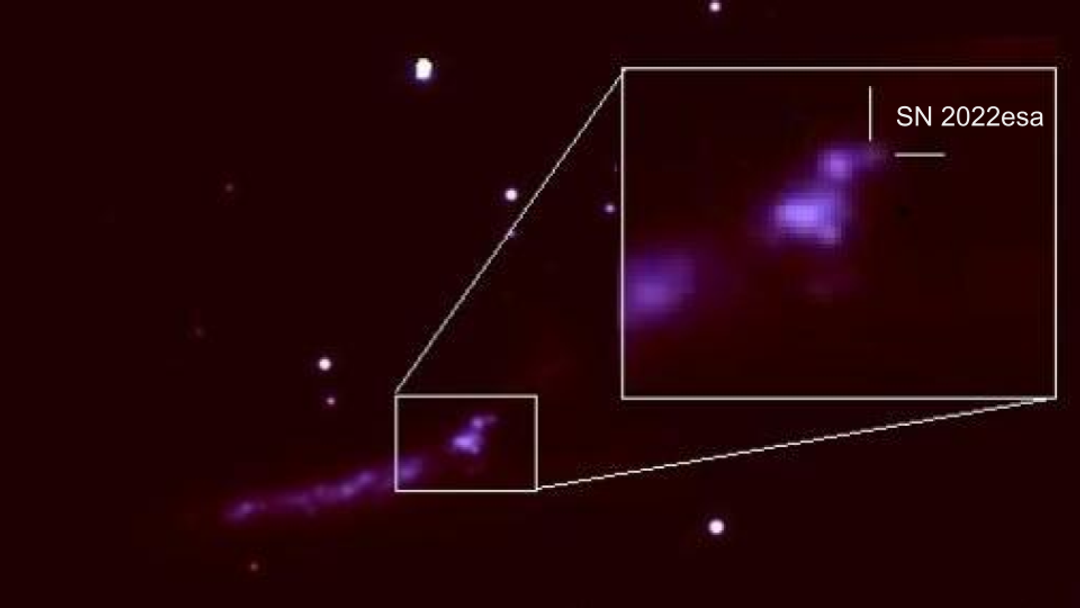
In 2022, a massive Wolf Rayet star was observed to explode as a supernova. As the star died, its collapsing outer layers ignited and rapidly expanded outwards as a supernova, but the massive interior continued to collapse, ultimately forming a black hole.
This research appears in Publications of the Astronomical Society of Japan with lead author Keiichi Mawda (Kyoto University).
This kind of stellar death hasn’t been seen before, and it was generally thought that stars in this mass range - stars at least 30 times larger than our Sun - should completely and unceremoniously collapse directly into black holes, without any burst of light from a supernova marking their formation.
Catalogued as SN 2022esa, this particular event appears to have been made possible by a companion star. Researchers find evidence that shells of material surrounded the exploding star, and they were likely created by periodic eruptions roughly once a year prior to the explosion. These periodic eruptions could have been triggered by a massive companion, such as another Wolf Rayet star or a black hole. Ultimately, this system could turn into a binary black hole system that will one day undergo a gravitational wave releasing merger, creating a single larger black hole. This will be far far in the future, and we will not be here to bring you that news when it happens, but it’s cool to think about.
Sources
Kyoto University press release
Keiichi Maeda, et al., Publications of the Astronomical Society of Japan, Volume 78, Issue 1, February 2026, Pages 1–7. DOI: 10.1093/pasj/psaf140

Supernova Caught Forming Black Hole
CosmoQuestX
3 days ago
Supernova Caught Forming Black Hole
3 days ago
In the somehow more than 30 years that I’ve been employed in astronomy as a student and then professional, we’ve gone from a time when having good data on 6 of some weird kind of object was considered statistically useful to a time when we have so much data that we find weird things by the thousand and rare things are turning up in dataset after dataset. This is allowing us to expand our understanding of stellar evolution from the easy to model case of a star evolving in isolation to the much more complicated situation of a star evolving with a neighbor.
Stars in binary systems have the capacity to share mass back and forth and otherwise alter one another's mass and chemistry over time.
And this can have dramatic consequences.
In 2022, a massive Wolf Rayet star was observed to explode as a supernova. As the star died, its collapsing outer layers ignited and rapidly expanded outwards as a supernova, but the massive interior continued to collapse, ultimately forming a black hole.
This research appears in Publications of the Astronomical Society of Japan with lead author Keiichi Mawda (Kyoto University).
This kind of stellar death hasn’t been seen before, and it was generally thought that stars in this mass range - stars at least 30 times larger than our Sun - should completely and unceremoniously collapse directly into black holes, without any burst of light from a supernova marking their formation.
Catalogued as SN 2022esa, this particular event appears to have been made possible by a companion star. Researchers find evidence that shells of material surrounded the exploding star, and they were likely created by periodic eruptions roughly once a year prior to the explosion. These periodic eruptions could have been triggered by a massive companion, such as another Wolf Rayet star or a black hole. Ultimately, this system could turn into a binary black hole system that will one day undergo a gravitational wave releasing merger, creating a single larger black hole. This will be far far in the future, and we will not be here to bring you that news when it happens, but it’s cool to think about.
Sources
Kyoto University press release
Keiichi Maeda, et al., Publications of the Astronomical Society of Japan, Volume 78, Issue 1, February 2026, Pages 1–7. DOI: 10.1093/pasj/psaf140