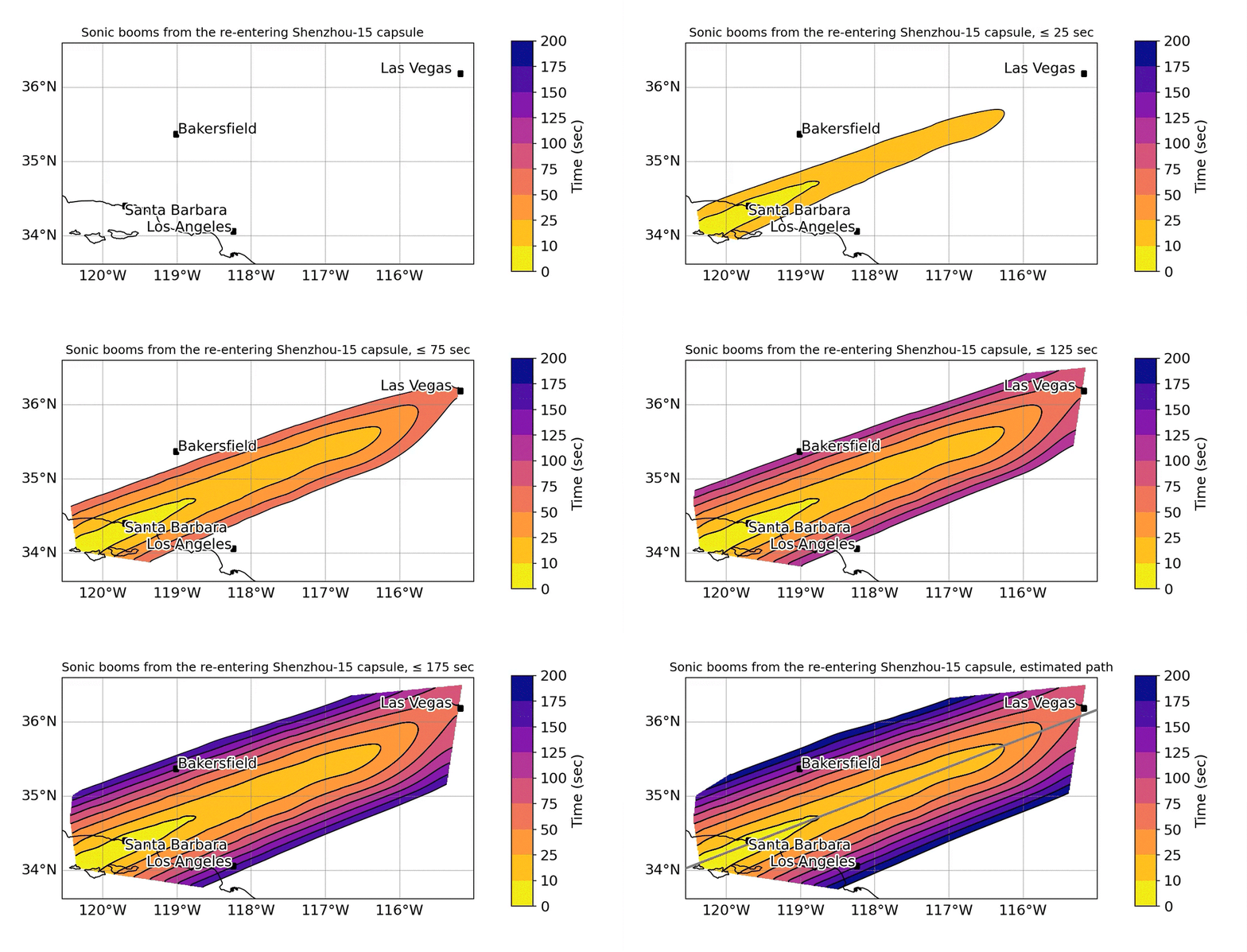
Credit: Benjamin Fernando / Johns Hopkins University
Credit: Benjamin Fernando / Johns Hopkins University
Seismometers track sonic space junk

CosmoQuestX
Yesterday
Seismometers track sonic space junk
Yesterday
Researchers Benjamin Fernando (Johns Hopkins University) and Constantinos Charalambous (Imperial College London) took advantage of the 2024 reentry of Shenzhou-15’s orbital module to test if seismometers - normally used to measure Earthquakes - could also be used to detect sonic booms associated with re-entering spacecraft.
Shenzhou-15 was a crewed Chinese mission to their space station. On re-entry, the crew module successfully carred a trio of astronauts back to Inner Mongolia, but the detached orbital module made an uncontrolled entry that was predicted for the North Atlantic and instead ended up being in the Pacific, off the coast of California. During re-entry, this 1500 kg module sped over North America at Mach 25-30, sending sonic booms across the landscape. By analyzing how and when these sonic booms appeared in data from 127 seismographs in Southern California, they were able to estimate the modules actual trajectory and see how it fragmented into multiple pieces over time.
This was only a test to see what’s possible… but it looks like, with sonic booming debris… tracking with seismic data may be possible.
And depending on just what kind of mission is re-entering, this kind of data may be crucial. Fernando relates the following, “In 1996, debris from the Russian Mars 96 spacecraft fell out of orbit. People thought it burned up, and its radioactive power source landed intact in the ocean. … More recently, a group of scientists found artificial plutonium in a glacier in Chile that they believe is evidence the power source burst open during the descent and contaminated the area. We’d benefit from having additional tracking tools, especially for those rare occasions when debris has radioactive material.”
I am all for a more scientific future, with powerful satellites enabling new ways of communicating, computing, and observing, but hand in hand with building that future, I look forward to seeing researchers like these finding ways to make sure that when satellites fall through the sky, we know where they’re going.
Sources
Johns Hopkins press release
AAAS press release
NASA JPL / Caltech article
Seismometers track sonic space junk
CosmoQuestX
Yesterday
Seismometers track sonic space junk
Yesterday
Researchers Benjamin Fernando (Johns Hopkins University) and Constantinos Charalambous (Imperial College London) took advantage of the 2024 reentry of Shenzhou-15’s orbital module to test if seismometers - normally used to measure Earthquakes - could also be used to detect sonic booms associated with re-entering spacecraft.
Shenzhou-15 was a crewed Chinese mission to their space station. On re-entry, the crew module successfully carred a trio of astronauts back to Inner Mongolia, but the detached orbital module made an uncontrolled entry that was predicted for the North Atlantic and instead ended up being in the Pacific, off the coast of California. During re-entry, this 1500 kg module sped over North America at Mach 25-30, sending sonic booms across the landscape. By analyzing how and when these sonic booms appeared in data from 127 seismographs in Southern California, they were able to estimate the modules actual trajectory and see how it fragmented into multiple pieces over time.
This was only a test to see what’s possible… but it looks like, with sonic booming debris… tracking with seismic data may be possible.
And depending on just what kind of mission is re-entering, this kind of data may be crucial. Fernando relates the following, “In 1996, debris from the Russian Mars 96 spacecraft fell out of orbit. People thought it burned up, and its radioactive power source landed intact in the ocean. … More recently, a group of scientists found artificial plutonium in a glacier in Chile that they believe is evidence the power source burst open during the descent and contaminated the area. We’d benefit from having additional tracking tools, especially for those rare occasions when debris has radioactive material.”
I am all for a more scientific future, with powerful satellites enabling new ways of communicating, computing, and observing, but hand in hand with building that future, I look forward to seeing researchers like these finding ways to make sure that when satellites fall through the sky, we know where they’re going.
Sources
Johns Hopkins press release
AAAS press release
NASA JPL / Caltech article